
Introduction-
It is a well known fact that the biological clock ticks faster for women, than men. Studies have very clearly shown that egg reserves and egg quality- both begin to drop and worsen once women are older than 35 years of age. But, what happens when you do not want to start a family right away, or have not found a suitable partner or have medical conditions that can affect fertility and your overall health? Don’t worry too much- egg freezing is your solution! Walk into Feminova Clinics today, if you have been searching for the Best Gynecologist In Chandanagar or a Fertility Clinic Near Me online.
What is Egg Freezing?
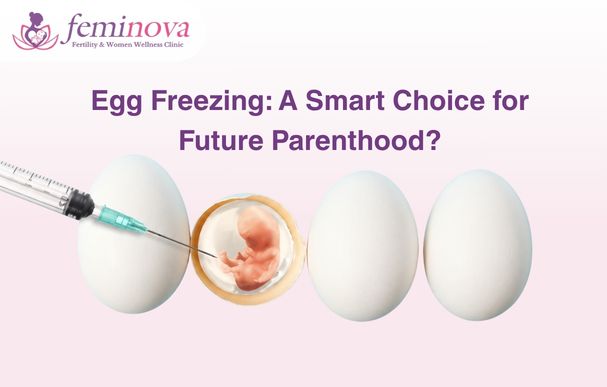
Egg freezing or oocyte cryopreservation is a type of ART- Assisted Reproductive Technology, where you will be given hormonal injections that tell your ovaries to release more than just one mature egg, as is usually the monthly norm. These eggs are then taken out while you are anaesthetised and then frozen in very low temperatures, in such a way that no ice crystals can form and harm the egg. Such eggs can be stored for about 10 years or even longer and can be used at a later date for fertilization with sperm and implantation into the uterus, for a pregnancy to continue.
Egg Freezing- The Process-
- Visit and Treatment Plan- First, you should schedule an appointment with an experienced fertility specialist and then get some basic tests done- hormone panel., blood tests, medical history etc.
- Ultrasound and Blood Work- You can opt to get a transvaginal ultrasound that checks the antral follicle count (AFC) or ovarian reserves. Once these values come back, your doctor will begin planning your treatment- how much hormone can be safely given for your ovaries to be stimulated enough to release multiple eggs, so that you don’t have to deal with ovarian hyperstimulation syndrome (OHSS). Doctors can also estimate how many eggs can be taken out to freeze.
- Stimulation and Ovarian Monitoring- Here, you will be given hormones or medications that help synchronise your follicles, so both of them will respond in a similar fashion to injections later on. You will be monitored closely using blood tests and ultrasound scans, so that the doctor can pinpoint when exactly you can begin self administration of FSH and LH injections.
- Hormonal Injections- FSH and LH are two gonadotropins that are normally given every day, for 10-12 days. You will inject them subcutaneously in the belly. Within a week or so, the ovaries will enlarge and once they have reached a good size, your doctor will ask you to take the trigger shot- which is HCG or lupron or both.
- Egg Retrieval- Here, you will be anaesthetised and then the released eggs are safely removed using a specially designed probe, transvaginally. An ultrasound will be used to guide the physician- the fluid in the follicles is then aspirated and added to tubes which are then given to an embryologist for tests. They will then use a microscope to check how many eggs can be used for freezing, by the time you wake up (about 20 minutes later).
- Recovery- Pain killers can be used to help you deal with cramping. You can rest for a while, if you notice spotting, bloating or constipation. If you have heavy vaginal bleeding, call a doctor immediately.
- Freezing or Vitrification- This is a process of freezing your eggs in such a way that no ice crystals are formed- so that there is no damage to the eggs, with liquid nitrogen.
Conclusion-
It is important to understand that since egg reserves and quality begin to decrease with increasing age, the older you are, the lesser number of eggs may be available for retrieval. This is marked- when you turn 40 or are older. Whatever age you may be, it makes no sense to waste time or wait and wonder what you could have done, when there is a clear option available right now- egg freezing.
Can't find an answer? Book a clinic visit or Call us at +91 9966888702 or +91 8125860069
What is egg freezing and how does it work?
Egg freezing involves retrieving mature eggs from the ovaries, freezing them, and storing them for future use. The process includes ovarian stimulation, egg retrieval, and cryopreservation. When needed, the eggs are thawed, fertilised, and transferred to the uterus as part of a fertility treatment cycle.
Who should consider egg freezing?
Egg freezing is considered by women who want to delay pregnancy due to career plans, medical treatments, or personal reasons. It is also recommended for those with conditions that may affect ovarian reserve, such as endometriosis, or those undergoing treatments like chemotherapy that can impact fertility.
At what age is egg freezing most effective?
Egg freezing is most effective before 35 years of age, when egg quality and quantity are higher. Freezing eggs at a younger age improves the chances of successful fertilisation and pregnancy later, as egg quality declines with increasing age.
How long can frozen eggs be stored?
Frozen eggs can be stored for several years without compromising quality due to advanced cryopreservation techniques. Storage duration depends on medical guidelines and regulations, but eggs remain viable as long as they are properly maintained in controlled laboratory conditions.
What are the success rates of egg freezing?
Success rates depend on the woman’s age at the time of freezing and the number of eggs stored. Higher numbers of high-quality eggs increase the likelihood of successful fertilisation and pregnancy. Outcomes also depend on laboratory standards and overall reproductive health at the time of use.