
Introduction
The term AI conjures futuristic images and lots of expectation- with respect to how it may change lives in different sectors. We are no strangers to the use of AI in IVF Clinics either. IVF Clinics are no longer places where retrieved eggs are just fertilised with sperm cells so that an embryo is formed, for it to be inserted into the uterus. It is a place where reproductive wellness is understood in great detail- and that begins by understanding what happens in IVF and how each step of the process is vital and needs to be performed at the right time for the best outcomes in the end.
Let us look at how we use AI at Feminova Clinics- the best fertility clinic in Hyderabad, below!
AI in The IVF Process- Necessary Or Not?
Let us look at how AI can help improve the workings of an IVF Clinic, though the overarching advantage is its ability to use predictive modeling based on specific algorithms, when specific parameters are used. These programs can help doctors understand how much there is a possibility of having a successful cycle- based on information like hormonal levels, detailed medical history, previous medication use and results of any genetic screening tests which may have been done previously.
The specific steps where such AI programs are used extensively include-
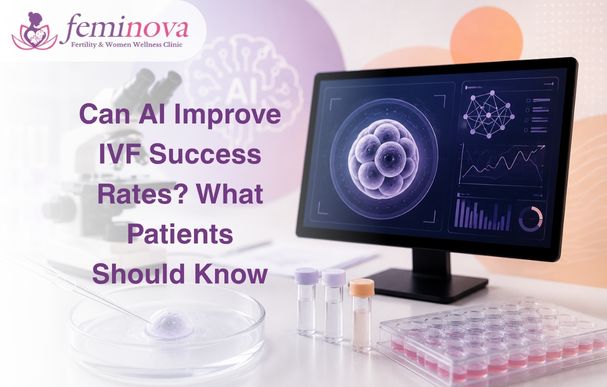
- Embryo selection- Previously, embryologists would have to take multiple images and then evaluate each of them carefully for any anomalies and to identify which embryo would be the best to insert into the uterus or decide which one would have the best chances of implantation. Now, there are programs which allow these AI programs to pick out the best embryo- as it has been trained extensively using thousands of images.
- Monitoring hormone levels or changes- Changes in hormone levels can be tracked in real time using AI programs- with data on estrogen and progesterone derived from blood tests, previous imaging tests and other information - to come up with the right kind of [protocol needed to stimulate the ovaries, prevent ovarian hyperstimulation syndrome (OHSS) and predict when best to extract mature eggs. They can also check for uterine receptivity, to improve changes of implantation after embryo transfer.
- Imaging of developing embryos- Embryos formed after fertilization are allowed to grow for 3-5 days in the lab. Time lapse imaging of these embryos can help us understand which one is the most well developed one, which can be transferred into the uterus.
- Semen analysis- AI algorithms can generate accurate reports after semen sample has been analysed. Semen samples can be analysed by an AI program to check for sperm number, motility and pick the ones with the best characteristics for ICSI- a cell that has good motility and has no structural abnormalities. When a patient has been diagnosed with azoospermia, it is not that they have no sperm cells at all. The count is very low- and AI platforms can find these sperm cells in the sample and retrieve them for further use. Another advantage is that sperm cells can be visualised without the need to stain them with specific dyes. Embryologists can hence pick viable sperm much more easily from a sample.
Advantages of Using AI in IVF-
These are the pros of utilising AI programs-
- There is greater precision and removal of human error.
- The predictive modelling ability can help a doctor map out how the IVF cycle may play out- and adjust their hormone medications and time egg maturation and retrieval better.
- Time is saved- as test results can be obtained faster, with lesser chances of mistakes being made.
Conclusion-
Using AI means that patient health data must be safeguarded using specific methods, as at the end of the day, it is just a tool- albeit a very advanced one that an experienced embryologist or doctor will use. Plus, AI is only as fair as the training models it has been given to work with initially- so there needs to be someone who can understand if the results given by the algorithm are biased or not. That comes with experience and a better understanding of the finer aspects of the IVF process.
Call us at Feminova Clinics- if you have been searching for the best IVF Clinic Near Me, best Male Fertility Clinic Near Me, or best Best Doctor For Pregnancy Near Me, online, today!
Can't find an answer? Book a clinic visit or Call us at +91 9966888702 or +91 8125860069
How is AI used in IVF treatment?
Artificial intelligence (AI) in IVF uses computer algorithms to analyse large amounts of clinical and laboratory data. AI-assisted tools can help assess embryo development, analyse images of embryos, and support certain decision-making processes during fertility treatment.
Can AI improve IVF success rates?
AI has the potential to improve certain aspects of IVF, particularly embryo assessment and treatment planning. By analysing patterns that may not be easily identified through manual evaluation alone, AI can provide additional information that supports clinical decision-making during an IVF cycle.
Does AI replace fertility specialists and embryologists?
No. AI is a support tool and does not replace fertility specialists or embryologists. IVF treatment decisions continue to rely on medical history, diagnostic findings, laboratory assessments, and the expertise of the fertility team.
Is AI used to select embryos for transfer?
Yes. Some IVF centres use AI-assisted systems to analyse embryo images and developmental patterns. These tools provide additional information that can complement conventional embryo grading and support embryo selection during the IVF process.
Should patients choose an IVF centre solely because it uses AI?
No. AI is one component of fertility care and should be considered alongside factors such as the experience of the fertility specialists, embryology laboratory standards, treatment options, and the centre's overall approach to patient care and clinical decision-making.