
Introduction -
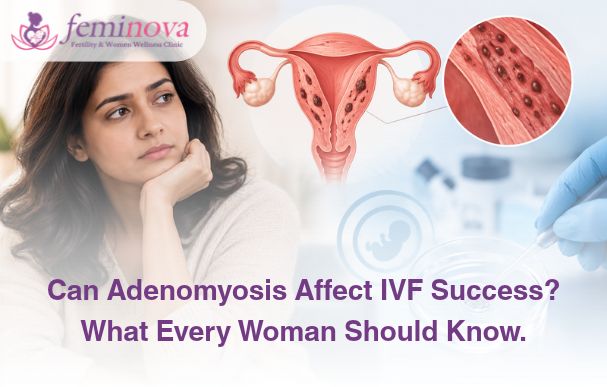
There is a particular kind of anxiety that comes with being told something unexpected during a fertility scan. You may have walked into the appointment thinking about your next period, your follicles or when you might finally move towards embryo transfer, and then, almost in passing, the doctor says, "You may have adenomyosis."
Suddenly a word you didn't know existed is sitting in the middle of a very personal journey, and before you have even had time to ask what it means, you are home searching for answers and finding phrases about implantation, miscarriage and IVF failure. It is understandable that your mind goes there. But adenomyosis is not a simple yes-or-no diagnosis when it comes to fertility.
Does Adenomyosis Need To Be Treated Before IVF?
Not necessarily, and this is one of those areas where reading too many fertility stories online can leave you more confused than reassured. This is because you may find one woman who was given several months of hormonal suppression before embryo transfer and another who was advised to proceed without it, even though both were told they had adenomyosis. There isn't one universally accepted plan that suits every woman.
Treatments such as GnRH agonists have been studied before IVF and may improve certain pregnancy outcomes in some circumstances, but evidence that they improve live birth rates remains less certain. Your specialist has to balance the possible benefit against your age, ovarian reserve, symptoms, the extent of the adenomyosis, previous treatment and the very real question of whether delaying an embryo transfer is sensible for you or not, in the long term.
Yes, IVF Can Still Work.
This is the part that deserves to be said before you spend too much time reading frightening statistics online: women with adenomyosis do become pregnant through IVF, and having the condition does not close the door on that possibility.
It may change the way your fertility team prepares for treatment, because some women may benefit from controlling symptoms or suppressing adenomyosis before an embryo transfer. For others, the possible benefit may not justify waiting - when age or ovarian reserve makes time an important part of the decision. The number and quality of embryos, previous IVF attempts and other fertility factors also matter, which is why there can never be one standard adenomyosis protocol that applies neatly to every woman who receives the diagnosis.
The Questions Worth Asking Before Your IVF Cycle-
If you've been told you have adenomyosis, your next appointment should ideally leave you with more understanding rather than another list of things to worry about. So instead of asking only whether IVF will work, ask what your adenomyosis actually looks like, whether it is focal or diffuse, how extensive it appears to be, whether your symptoms make it more clinically significant and whether there are other conditions, such as endometriosis, that need to be considered.
If treatment before embryo transfer has been suggested, ask what the evidence says, what benefit your doctor expects it to provide and what the downside of waiting might be, because the balance between those two things can be very different for a 30-year-old with a good ovarian reserve and a woman whose ovarian reserve or age makes time a more pressing consideration.
Conclusion-
To learn more about chronic conditions like adenomyosis or endometriosis and how they can affect your fertility journey, please consider getting in touch with experienced fertility specialists at Feminova Clinics sooner rather than later!
Can't find an answer? Book a clinic visit or Call us at +91 9966888702 or +91 8125860069
Can I Get Pregnant Naturally If I Have Adenomyosis?
Yes. Adenomyosis does not make natural pregnancy impossible, although fertility may be affected in some women depending on the extent of the condition, age and other reproductive factors. If you are trying to conceive, a consultation with a Fertility Specialist or a Gynecologist can help determine whether adenomyosis is likely to be affecting your individual fertility.
Does Adenomyosis Always Reduce IVF Success?
No. Research suggests that some forms, particularly symptomatic or diffuse adenomyosis, may have a greater effect on IVF outcomes, while asymptomatic adenomyosis may not affect outcomes in the same way. If you are considering an IVF Clinic or looking for the Best IVF Doctor In Hyderabad, your specialist can assess the condition alongside your age, embryo quality and other fertility factors.
Should Adenomyosis Be Treated Before IVF?
Not every woman needs treatment before IVF. Your fertility specialist may consider hormonal suppression or other approaches depending on your symptoms, imaging findings, previous fertility history and treatment plan, particularly if you are seeking IVF Treatment in Hyderabad and need to decide whether treatment should begin before embryo transfer.
Can Adenomyosis Cause Miscarriage After IVF?
Studies have found an association between adenomyosis and increased miscarriage risk in IVF, but this does not mean that miscarriage is inevitable. Your individual risk depends on several factors beyond adenomyosis, which is why an experienced Fertility Clinic In Hyderabad will consider your complete reproductive history rather than the diagnosis alone.
Can Adenomyosis Be Seen On A Fertility Ultrasound?
Yes. Certain features of adenomyosis can be identified through transvaginal ultrasound, although MRI may sometimes be used when the diagnosis is unclear or a more detailed assessment is needed. If you are looking for a Fertility Center or a Fertility Specialist, ask whether detailed uterine assessment is part of your fertility evaluation.