
Introduction-
The decision to talk to a fertility specialist is a big one for couples- as there are so many expectations and preconceptions involved. There is no single best fertility treatment that can work wonders for everyone- each of your needs are different and the best option is one that is personalised and caters to you. So, walk into Feminova Clinics so you can decide when IUI, IVF and ICSI are necessary in your fertility journey, as we have the best IUI Doctor in Nallagandla and offer the best ICSI Treatment in Hyderabad, among others. Call us if you have been searching for the best IVF Clinic In Hyderabad.
IUI vs. IVF vs. ICSI - Differences You Should Know-
Let us look at what each of these procedures are, in greater detail below-
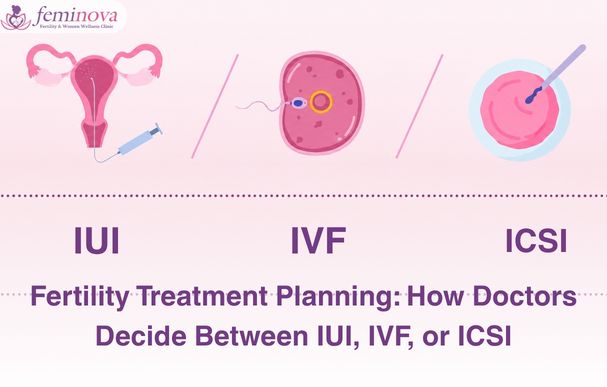
- IUI- Intrauterine insemination is a procedure that is the closest to natural conception- it is a simple process where sperm is inserted directly into the uterus using a probe when you are ovulating. Then you have to wait for the sperm to fertilise the egg that will be released and hope for implantation to occur. This procedure is helpful when there are minor sperm motility issues or unexplained infertility or when ovulation is irregular. If you want to learn more, call us at Feminova Clinics, as we are the Best IUI clinic in Hyderabad.
- IVF- In-vitro fertilisation is an assisted reproductive technology (ART) where eggs and sperm are fertilised in a lab. The best eggs and sperm are chosen, so your chances of getting pregnant are high. The embryo thus formed is then placed into the uterus, where it can implant successfully, for pregnancy to occur. This process bypasses a lot of the normally occurring hurdles- like blocked fallopian tubes, irregular ovulation, poor sperm count or motility, endometriosis, if you have a low egg count or unexplained infertility has been an issue for a while.
- ICSI- Intracytoplasmic sperm injection- This is the preferred method of treatment when male factor infertility is the issue. ICSI can be thought of as a type of IVF- where one healthy sperm cell is selected and then injected into the egg. This is done when sperm morphology or structure is abnormal, motility is poor and count is low. It is also an option to consider if repeated rounds of IVF have not worked. Since the sperm is directly injected into the egg, it bypasses fertilisation barriers. The embryo is then inserted into the uterus, where it can implant and continue growing.
Choosing The Right Option For You
The best option is the one that takes into consideration your needs, health parameters and any underlying conditions that you may have, which may be impacting fertility and your ability to get pregnant.
The other factors to consider include age, egg reserves, previous treatments if any and your budget.
Conclusion
Most fertility specialists recommend starting with IUI- as it is the closest to natural conception, with just a little more assistance given. IVF is the choice when IUI has not worked and there are other factors in play- like infertility, blocked fallopian tubes or male factor infertility. ICSI is a very specialised form of IVF used to treat male infertility and maximise your chances of success.
So, whatever may be your concerns or your goals, please know that we at Feminova Clinics will work hard to understand what the problem is and come up with a solution that is both pocket and goal friendly in the long run. So, call us today if you have been looking for the best Women Clinic Nearby .
Can't find an answer? Book a clinic visit or Call us at +91 9966888702 or +91 8125860069
How do doctors decide between IUI, IVF, and ICSI?
Doctors base the decision on age, duration of infertility, sperm quality, ovulation status, and fallopian tube health. IUI is used when sperm count and tubes are adequate. IVF is chosen for tubal damage or failed IUI cycles. ICSI is selected when sperm count, motility, or morphology is significantly impaired.
When is IUI recommended in fertility treatment?
IUI is recommended for mild male factor infertility, ovulation disorders, or unexplained infertility with open fallopian tubes. It involves placing processed sperm directly into the uterus during ovulation. This method is less invasive and lower cost, but success rates are lower compared to IVF in cases with multiple contributing factors.
When do doctors suggest IVF instead of IUI?
IVF is advised when fallopian tubes are blocked, endometriosis is present, or multiple IUI cycles have failed. It is also preferred in women over 35 with reduced ovarian reserve. IVF allows fertilisation outside the body and enables embryo selection, improving the chances of implantation in complex infertility cases.
Why is ICSI used in some IVF cycles?
ICSI is used when sperm cannot fertilise the egg on its own due to low count, poor motility, or abnormal morphology. A single sperm is injected directly into the egg to ensure fertilisation. It is also used in cases of previous fertilisation failure or when sperm is retrieved surgically.
Does age affect the choice between IUI, IVF, and ICSI?
Age directly influences treatment choice because egg quality and ovarian reserve decline over time. Women above 35 are often advised IVF earlier to improve success rates. Younger women with normal investigations may begin with IUI, while advanced age or poor ovarian reserve shifts the plan toward IVF or IVF with ICSI.