
What Is Embryo Cryopreservation? Benefits and Process Explained
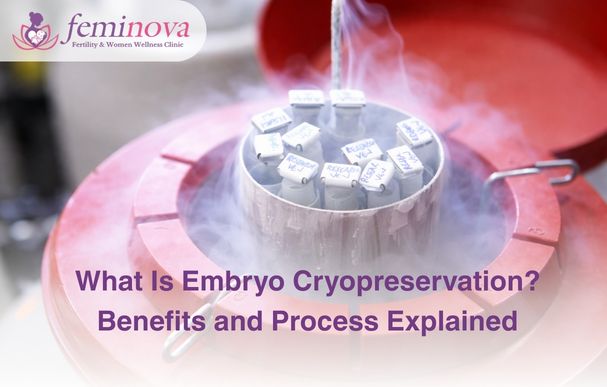
Introduction– Scientific advancements in the field of fertility have been growing rapidly, giving hope to many couples who may not be able to conceive. Many procedures like IVF, in-vitro gametogenesis, genetic editing, pre implantation genetic testing and cryopreservation are now being used to help individuals in very scientific ways. An embryo is a by-product from the process of fertilization which includes a mature egg and sperm. Embryo cryopreservation or embryo freezing is a process that is used to freeze healthy fertilized eggs for future use. In countries like India, embryo freezing is an exceptional choice for couples who choose to protect their fertility for various reasons. Couples with high risk conditions like cancer, endometriosis, and ovarian failure can preserve their ability to conceive, with this technique. The success rate of frozen embryo transfers is about 60% for women under the age of 35yrs in India, according to various studies that have been conducted.
Why Freeze Embryos?
Excess embryos are quite common in couples trying to conceive through IVF. These can be used for the future by freezing them. This process is called cryo-preservation. It is helpful in cases when the couple wants to cancel or postpone an implantation after one good fertilized egg, or if they want to have the choice to try again, if one round of IVF fails. They may also choose to donate them to other couples who are trying to get pregnant or for research purposes.
Process Of Embryo Cryopreservation-
The interested couple must visit a fertility clinic, where they will be asked to get a few preliminary tests done. Once the results are out and the doctor gives the go ahead, the process begins.
- Egg collection: The doctor will first sedate you and then collect multiple eggs at once, using a hollow needle and catheter. This process is also called egg retrieval.
- Fertilization:Later, these collected eggs are all fertilized under the guidance of an embryologist with the sperm collected from your partner. The fertilization of an egg takes place in a petri dish within a lab setting for 7 days. These embryos are then sent for genetic testing to identify any genetic conditions or anomalies.
- Embryo grading: Once genetic testing is done, the embryos are graded for their higher feasibility and successful growth for implantation.
- Vitrification: The highly graded embryos are then carefully frozen using liquid nitrogen to prevent ice crystals from forming, that could damage the embryonic cells.
- Storage in Bank-The storage of these embryos is usually in a lab and they can be safely preserved for 10 yrs or even longer. If an egg is collected from a woman aged below 35yrs, there is about a 95% chance that the frozen embryos can survive the thawing process.
Process Of Using The Frozen Embryos For Pregnancy:
Once you decide to get pregnant, FET (Frozen embryo transfer) begins. The mother usually receives oestrogen pills or injections for improving the uterine lining and progesterone treatment to make the uterus safe for embryo. In cases where the mother has natural cycles, the doctor waits until ovulation and then the embryo is transferred into the uterus 5 days after ovulation. This is called natural FET (Frozen embryo transfer).
Benefits Of Cryo-Preservation:
- It is useful for couples who don’t wish to get pregnant any time soon.
- Couples with fertility issues.
- Helpful for couples that undergo treatments which damage their fertility.
- Women who are uncertain of their partners can choose for their eggs to be frozen & get fertilized with donor sperm at a later date.
Risks:
You should be aware of the risks associated with this procedure, even if it is a minor one.
- Damage to the embryos while freezing
- Weak embryos that do not fit the criteria cannot be frozen
- Failure to get pregnant even after implantation
- Higher incidence of age related pregnancy risks.
- Multiple births if more eggs are implanted.
Conclusion – Cryo-preservation of embryos is one of the best techniques available, in today’s world for couples trying to conceive, who are otherwise not able to do so under normal circumstances. Individuals and couples these days choose to defer having babies due to a variety of reasons. Cryo-preservation helps couples in the future, when there is better stability in their personal and financial life. Couples opting for embryo cryo-preservation should consult the best IVF Clinic In Hyderabad in such cases. So, come to Feminova, for an unbiased and non -judgemental session and walk out with more confidence than when you came in!
Can’t find an answer? Book a clinic visit or Call us at +91 9966888702 or +91 8125860069
Is IVF more successful with embryo cryo-preservation?
Not necessarily, but the success rates of frozen thawed embryo transfers are similar to fresh embryo transfers.
Does freezing the embryos damage them?
Yes, not all embryos survive the process, but changes in vitrification techniques like usage of different cryo-protectants can help in reducing risks, allowing for high survival rates.
Can a couple get pregnant even after menopause through cryo-preservation of embryos?
Yes, a couple can get pregnant even after menopause through cryo preservation of embryos, with associated hormonal therapy and subsequent in-vitro fertilization.
What is the age limit of embryo cryopreservation?
There is no fixed age limit for this process; it depends on factors like duration of storage and biological age of the couple opting for the procedure.
Are freezing eggs and freezing embryos the same?
No, freezing eggs means preserving unfertilized mature eggs that offer options to individuals who are unsure about their partners, while embryo freezing is a good choice in preserving fertilised eggs – this is useful for couples who are opting for a pregnancy a few years later.