
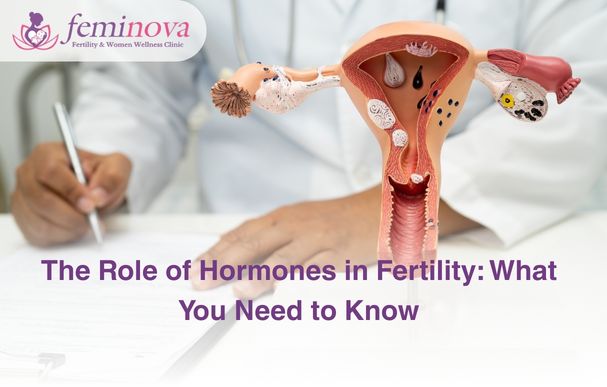
Introduction– Fertility is generally defined as the ability of an individual to conceive or have children. But, the process of conception has many steps, all of which are governed by various hormones and other pathways. If any one of these hormones or pathways don’t work right, then the individual may have to deal with infertility. PCOS is the single most well known cause for wreaking havoc on a woman’s hormonal and reproductive health. If you have been searching for ‘best PCOS clinic near me’ online, then walk in to Feminova Clinic today!
Hormones Involved in Fertility-
There are many hormones that are necessary for a woman to be able to conceive. Hormone levels are never constant and instead peak and drop – which is how women have menstrual cycles, roughly every month or so. The 4 main hormones that regulate the whole process and reproductive health of a woman include-
- LH- Luteinising Hormone- This hormone works with FSH during ovulation, by triggering the release of a mature egg from the ovary. When LH levels surge in the middle of your menstrual cycle and this determines the peak of your fertile window. High LH values may indicate PCOS in women. It can lead to missed periods or irregular ovulation.
- FSH- Follicle Stimulating Hormone – FSH is produced by the pituitary gland. Development and maturation of the ovaries occurs due to FSH in females. Both high and low levels of FSH can be problematic. High FSH levels occur due to primary ovary insufficiency. Low levels of FSH can lead to infertility in both men and women.
- Oestrogen – Oestrogen is a hormone produced by fat cells, the ovaries and the adrenal glands. Oestrogen levels are the highest in your fertile window. One of its functions is to thin cervical mucus- allowing sperm to make their way to the egg in an easier manner. Oestrogen causes the endometrial lining to grow and thicken every month, so implantation can occur, if fertilisation takes place. Normal oestrogen levels can mean that your menstrual cycle is regular.
- Progesterone – After the mature egg has been released, the corpus luteum in the follicle triggers the release of progesterone. This hormone’s levels will continue to increase if fertilisation and implantation occur. But, if fertilisation has not occurred, then the corpus luteum will degenerate, causing progesterone levels to fall, till the next LH surge causes it to increase, in the following cycle. Progesterone levels keep increasing for a few weeks, even after pregnancy has been established. This occurs, so as to allow time for the placenta to grow. Once the placenta is around 12 weeks, it begins to produce progesterone on its own, which will then continue to sustain the pregnancy till term.
- Prolactin and TSH issues can also impact fertility in women.
In men, both FSH and testosterone are important in making sure that enough sperm cells are produced and that they are motile. LH helps in production of testosterone by the testes. If thyroid hormones are affected, then LH, FSH and testosterone action can go haywire.
Hormonal Imbalance and PCOS-
The 3 hormones- LH, FSH and oestrogen help ovulation and occurrence of monthly menstrual cycles. When the hormones are not in the right levels, you may have to deal with PCOS related symptoms. For men, it can translate to poor sperm quality and low count.
This hormonal imbalance can impact fertility- as ovulation becomes irregular, egg maturation does not occur, excessive hair growth and symptoms caused by high levels of androgens.
Conclusion– Hormonal imbalances – either highs or lows can be frustrating to deal with- as they can impact fertility negatively. But there is no need to despair. You will need medication and have to make lifestyle changes- so that hormone levels get back within range. You will need specialised PCOD treatment in Hyderabad, if you have not been able to conceive. So, walk in to the Feminova Clinic in Nallagandla, as we are the best fertility clinic in Hyderabad. Call us today!
Can’t find an answer? Book a clinic visit or Call us at +91 9966888702 or +91 8125860069
How do hormones influence fertility?
Hormones regulate the reproductive cycle and control ovulation, sperm production, and sexual function. In women, hormones such as estrogen, progesterone, FSH, and LH regulate egg development and ovulation. In men, testosterone and FSH support sperm production. Imbalances in these hormones can interfere with conception.
Which hormones are most important for female fertility?
Key hormones include follicle-stimulating hormone (FSH), luteinizing hormone (LH), estrogen, progesterone, thyroid hormones, and prolactin. FSH and LH regulate ovulation, estrogen supports egg maturation, and progesterone prepares the uterus for implantation. Disruptions in these hormones can lead to irregular cycles or ovulation problems.
Which hormones affect male fertility?
Male fertility depends on testosterone, follicle-stimulating hormone (FSH), and luteinizing hormone (LH). Testosterone supports sperm production and sexual function. FSH stimulates the testes to produce sperm, while LH signals the testes to produce testosterone. Imbalances can reduce sperm count and affect reproductive health.
How are hormone imbalances diagnosed in fertility evaluations?
Doctors use blood tests to measure hormone levels such as FSH, LH, estrogen, progesterone, testosterone, thyroid hormones, and prolactin. Tests may be timed with the menstrual cycle in women. Imaging tests or additional evaluations may be used to identify underlying endocrine or reproductive disorders.
Can hormone-related fertility problems be treated?
Hormonal fertility issues can often be managed with targeted treatment. Doctors may prescribe medications to stimulate ovulation, regulate hormone levels, or improve sperm production. Treatment may also include managing thyroid disorders, reducing high prolactin levels, or addressing conditions that disrupt normal hormone balance.